Why We Call It The Existential Gallery
Why The Existential Gallery?
The word existential may sound overly philosophical, but its meaning is quite simple: pertaining to human existence.
Who am I? Why am I here? Why are we here? What came before us? What will come after us? How did this extraordinary universe come to exist, and how is it possible that we are able to perceive it, question it and try to understand it?
Sometimes there are answers. Often there are not.
Human beings have been asking these questions since the beginning of recorded time. Our ancestors looked at the same sun, moon and stars that we see today and wondered about their place in the universe. In many ways, that is also what art is about. Artists make visible our attempts to understand existence.
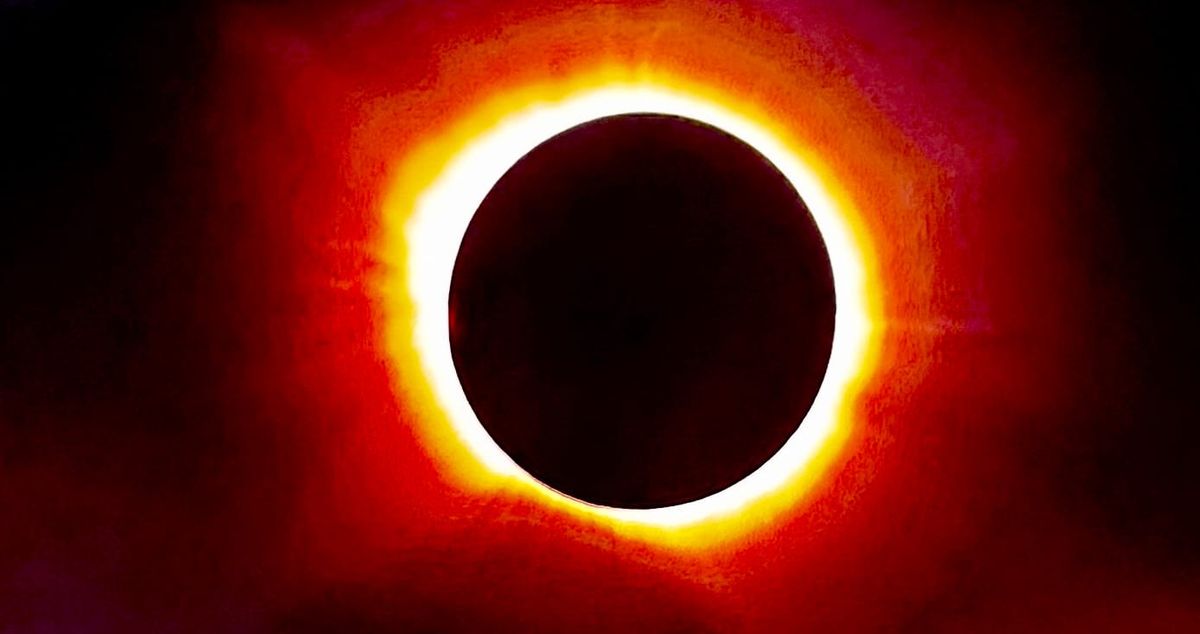
An eclipse seems to encompass all of this. For a few extraordinary minutes, something we take completely for granted—the sun shining in the sky—is transformed. It’s all very surreal. The familiar becomes mysterious. We become intensely conscious of the universe around us and of our own small place within it. And how did our long-ago ancestors deal with this? Then the sun reappears, people cheer, and somehow the world doesn’t seem quite the same.
Great art can do the same thing.
I remember seeing Renoir’s The Swing for the first time in the French Pavilion at Expo ’67. His astonishing interpretation of sunlight and colour changed the way I understood what a painting could do, much more than any other had ever done.
Thirteen years earlier, as a schoolboy in England, I had stood in the playground at Uxendon Manor School and watched a 97% partial eclipse of the sun. That experience was equally astonishing, perhaps even greater for an eleven year old schoolboy. For a short time, the ordinary world became something extraordinary for both me and my pals.
Those two events—a celestial event in a school playground and an encounter with a great painting at Expo ’67—are separated by years and circumstance, but in my memory they are significantly connected.
Both changed the way I saw.
That is the experience we hope for in an art gallery. You enter carrying your existing understanding of the world. Then you encounter something—a painting, a sculpture, a photograph, an installation, perhaps an idea you have never considered before—and suddenly you see something differently.
You may understand the artist. You may understand another culture or another generation. You may think about your ancestors. You may understand the world a little better.
Sometimes, unexpectedly, you understand something about yourself that hadn’t revealed itself previously.
That is why the name The Existential Gallery of Scarborough is significant.
It isn’t simply a name for a building in which art is displayed. It describes what we believe art can do.
Art asks the great questions of human existence. It connects us with those who came before us and with people whose experiences are very different from our own. It can disturb us, delight us, puzzle us and occasionally give us one of those rare moments when something suddenly becomes clear. Perception is forever changed.
Like watching the sun emerge from an eclipse, great art can bring us back into the light seeing the world differently.
And sometimes that new understanding stays with us for the rest of our lives.
Peter Marsh
August 12, 2026