
From Camera to Archive: Color Reference Essentials
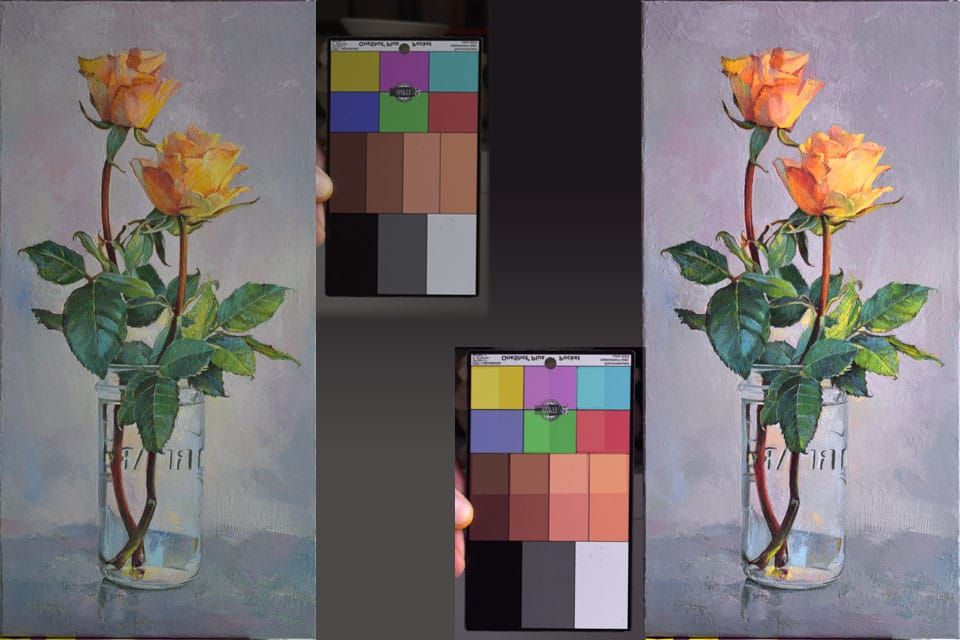
If you’re undertaking the important work of digitizing artwork—whether your own collection or pieces you’re preserving for posterity—there’s a critical technical standard you need to understand before investing significant time in the process. This article explores why professional archival institutions require color reference charts, and what it means for independent artists and small galleries.
Federal archival standards (FADGI – Federal Agencies Digital Guidelines Initiative) used by the Library of Congress, National Archives, and major museums worldwide require color reference targets for any digitization intended for archival purposes. Without them, images cannot be validated for color accuracy and may not be accepted as legitimate archival documentation by institutions.
Color reference charts—such as X-Rite ColorChecker or DSC Labs targets—must be photographed alongside artwork to create a verifiable standard. RAW files with maximum color depth are also required. This isn’t arbitrary bureaucracy; it’s the only way to ensure that colors can be accurately reproduced decades into the future as display technologies evolve.
The film industry faced this exact challenge and developed solutions we can learn from. The Academy of Motion Picture Arts & Sciences created ACES (Academy Color Encoding System) as the global standard for film archival specifically because:
Netflix’s archival specifications make this explicit: original RAW or high bit-depth footage must be preserved as “Non-Graded Archival Master” (NAM), while final edited/graded versions are considered derivative works, not archival masters. This approach allows future re-mastering as display technology evolves.
The same principle applies to digitizing artwork. Without color-referenced RAW files, you’re essentially creating “graded” images that document “how it looked on your monitor that day” rather than creating true archival records that can be:
For artists and small galleries, implementing color reference standards doesn’t require a Hollywood budget. Basic steps include:
Please check provided above reference materials
While this may seem like technical overkill for personal projects, consider what you’re trying to achieve. If your goal is simply to have nice images for social media or a website, color reference may be unnecessary. But if you’re creating archival documentation—whether for insurance purposes, future estate management, institutional donation, or historical preservation—implementing these standards from the beginning saves the considerable effort of re-doing everything later.
The question to ask yourself: are you documenting for today, or preserving for tomorrow?
This article draws on industry standards from the film, museum, and library archival communities. For specific implementation guidance for your collection, consult with a professional digital archivist or reach out to Gallery X Scarborough.
Dariusz Wieczorek October 11, 2024